
The honest answer is: it depends on three things, not one. What you can run depends on your inverter's power rating, how long depends on your battery's capacity, and whether you can keep running for days depends on whether solar panels are recharging the system while the grid is down.
Most guides skip straight to "buy a bigger battery." Before that decision makes sense, it helps to know what your everyday appliances actually draw, both to run and to start, because those two numbers decide whether an appliance runs at all during an outage.
Three components do three different jobs. Solar panels generate electricity during the day. The battery stores what you don't use immediately. The inverter converts stored DC power into the AC power your appliances actually run on, and manages the handoff between solar, battery, and grid.
During an outage, a hybrid inverter switches the household over to battery power automatically, without you flipping a switch. What limits you at that moment isn't the battery alone. It's the inverter's maximum output in watts, which determines whether a given appliance can start at all, regardless of how much energy the battery has stored.
This is also why two systems with the same battery capacity can behave completely differently. A large battery paired with an undersized inverter still can't start a high-draw appliance, because the inverter simply can't deliver the peak wattage the motor needs for that first second or two.
Every appliance has two numbers that matter: running wattage and starting wattage. A fridge, for example, draws only 132-192W once it's running, but its compressor motor pulls roughly 1,200W just to start [1]. Undersize your inverter for that starting surge and the fridge won't switch on, even if the battery is full.
These draw little enough that a modest system keeps them running through a long outage without much strain. A flat-screen TV runs on 120-190W depending on size, a laptop draws 200-250W, and a Wi-Fi router or phone charger adds only a few watts more [1]. Eskom's own guidance notes that a 10-amp, roughly 2.3kW supply is already enough to cover lighting and low-consumption devices like these [2]. For most households, this tier alone covers what matters most during a routine evening outage: light, connectivity, and a working phone.
A refrigerator runs on 132-192W but needs about 1,200W to start [1]. A microwave draws 1,000-1,500W depending on size, and a washing machine runs at roughly 1,200W [1]. None of these will drain a properly sized battery in minutes, but running several together noticeably shortens how long the system lasts before it needs recharging. A fridge cycling on and off through a multi-hour outage, plus a microwave used twice, adds up faster than most people expect when they're only picturing one appliance at a time.
This is where most home battery systems hit their ceiling. An 8-inch electric stove element draws 2,100W, a geyser draws 4,500W, and a tumble dryer needs roughly 6,750W just to start, all requiring a 240V-capable circuit [1]. Table 1 below shows why: these loads alone can exceed what a small inverter can output, before you've added anything else. Running any one on an undersized system trips the inverter or drains the battery within an hour, which is why most homes reserve these for generator power or grid power once it's back.
Table 1: Approximate appliance wattage
|
Appliance |
Starting watts |
Running watts |
|
Refrigerator/freezer |
1,200 |
132-192 |
|
Microwave oven |
1,000-1,500 |
1,000-1,500 |
|
Flat-screen TV (46") |
190 |
190 |
|
Laptop |
200-250 |
200-250 |
|
Washing machine |
1,200 |
1,200 |
|
Electric stove (8" element) |
2,100 |
2,100 |
|
Geyser |
4,500 |
4,500 |
|
Tumble dryer |
6,750 |
5,400 |
Source: Eskom appliance power consumption chart [1]
Three numbers decide the answer, and they answer three different questions. What it can run is set by the inverter's watt rating. How long it runs is set by the battery's stored capacity. Whether it keeps running past a day or two is set by whether solar panels are recharging the battery while the outage continues.
That third factor is what separates a battery that gets you through an evening from a system that gets you through a multi-day outage. A battery alone is a fixed reserve. A battery paired with solar panels recharging it during daylight hours is closer to a renewable supply, provided the inverter and panel capacity are sized to match what you actually run.
In practice, sizing works backward from your appliance list rather than forward from a battery's rated capacity. List what you actually need running, note the highest single starting wattage on that list, and size the inverter and battery around that combined figure rather than a round number that sounded big enough in a showroom.
THOE's household energy storage system combines a hybrid inverter with MPPT solar charging in a single unit, so the system captures and converts solar power with less loss than a separately wired setup [3]. The battery uses LiFePO4 cells rated for 6,000 charge cycles, with a battery management system that tracks voltage, temperature, and charge state to prevent overcharge and short-circuit risk [3].
For households that need to run higher-draw appliances like a stove or geyser, THOE's system supports parallel expansion to add capacity rather than replacing the unit outright [3]. One honest limitation: the exact battery capacity in kWh and inverter output in kW aren't published per configuration on the THOE household energy storage system page, so matching a system to your own appliance list means confirming those numbers directly with THOE rather than reading them off a spec sheet.
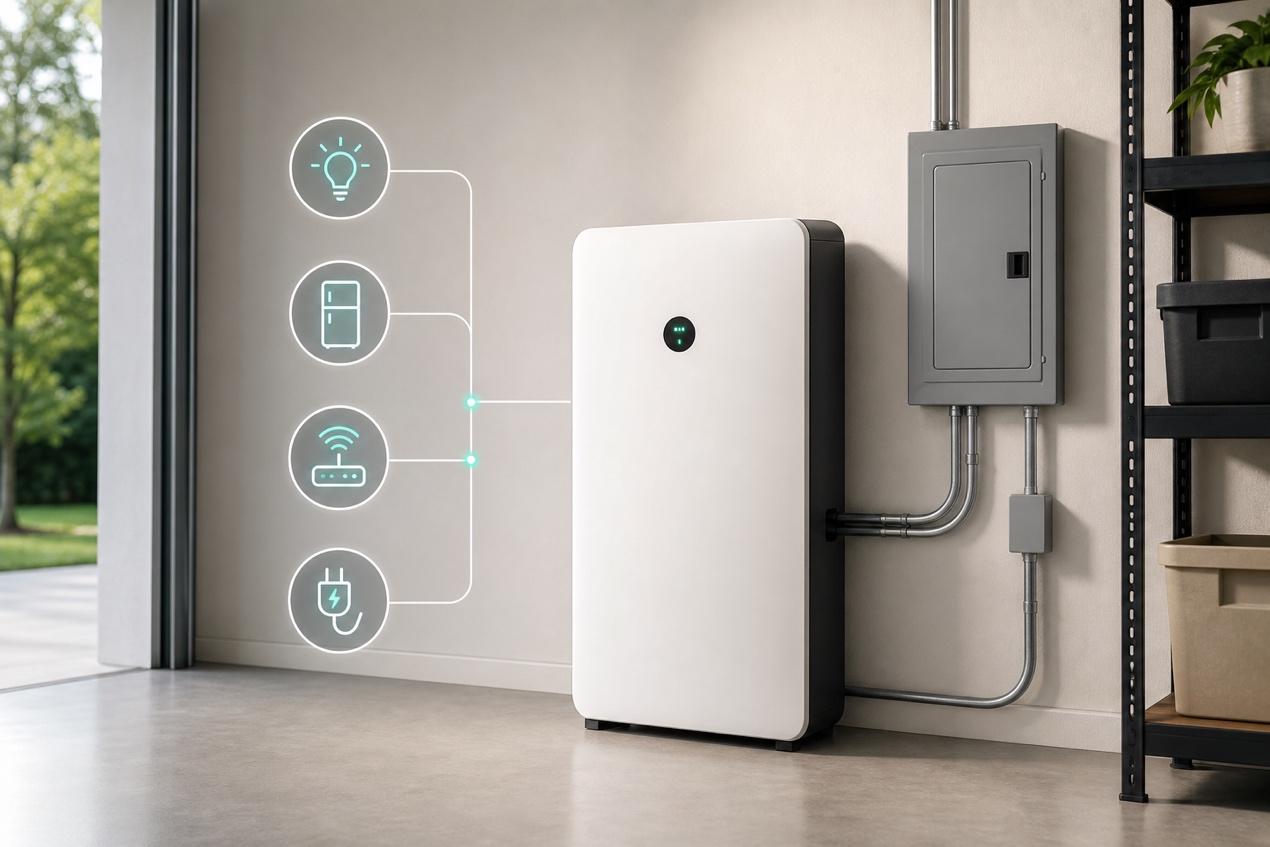
Sizing a home energy storage system starts with your appliance list, not the other way around. Add up what you actually need running during an outage, check the starting wattage of the biggest single item on that list, and size the inverter to cover both.
Explore THOE's household energy storage systems to find a configuration matched to your actual appliance list, not a generic one.